All the Snacks and Plastics Coming At You Are Hard to Avoid
In my previous two posts (How Sweet It Is – or Is It?) and (Sweet-Drink Free Sunday), I put a lot on YOU! Instead, I would like to help you find some of the Ease that I wrote about in my very first post.
Ease: Making the Healthy Choice the Easy Choice
If you’ve been lucky enough to go to Europe maybe you’ve seen the traffic light system for food labels. The color-codes highlight a food’s calories, fat, saturated fat, sugar, and salt — green shows low in a particular nutrient, yellow means medium, and red reveals a high amount. When you “see red” it’s a good idea to cut down, eat less often, or eat smaller amounts of that food.

Honestly, although this could be a helpful way to look at foods, I’m glad we do not have this system in the U.S. because it all can be pretty confusing.
What I think would be lots better is to put traffic lights on entire aisles in the grocery store. There are some aisles that if avoided could help keep less than healthful foods out of your home. And that will help you make the healthy choice the easy choice.
When you fill your shopping cart at the grocery store — or even better your basket at the farmer’s market — with fresh fruits and vegetables, your snack choices at home will be much healthier. What if we put a big red stop sign on the soda aisle? You could then pass up lots of sugar and plastic bottles at the same time. If you hit the produce section — with its imaginary green light — and skip the red-light district of the chip aisle, you’ll have crunchy fruits and vegetables to snack on and no plastic snack bags to toss in the trash.
But it’s tough! You are purposefully being marketed all kinds of unhealthy foods that are designed to make them simple to crave and over consume. What I’m saying is it’s not your fault! These foods are hard to resist. But if you can avoid strolling down the soda and snack food aisles and do not bring those tempting foods into your home environment, then the battle is won — for your health and for the earth.
Beyond Plastic Recycling
As you’ve been reading my posts about sugar and the plastic containers they are bottled in, maybe you’ve been thinking, “Can’t I just recycle the plastic containers from my sweet beverages?” “And those chip bags have #4 on them, so I could recycle those, too, right?”
Well, that just doesn’t seem to work. Unlike glass and paper, plastic doesn’t recycle really well. Plastics are made of so many toxic chemicals that they are almost impossible to recycle or repurpose into other products. The process of recycling and the products made from recycled plastic can be hazardous to our health and environment. Switzerland-based Food Packaging Forum recently published a review of hundreds of scientific studies and concluded that “reusing and recycling plastics can lead to unintended negative impacts, because hazardous chemicals, like endocrine disruptors and carcinogens, can be released during reuse and accumulate during recycling.”
When states in the U.S. were starting to pass laws for bottle bills to help solve litter and landfill challenges, the soda companies didn’t like it. To them, even though people could get their deposits back, bottle bills were like a tax that would drive up the cost and lower purchases of their products and thus their bottom line. So what did they do? The said Let’s put all the responsibility on the consumer and get them to recycle! No bottle bill for us! Recycling rules!
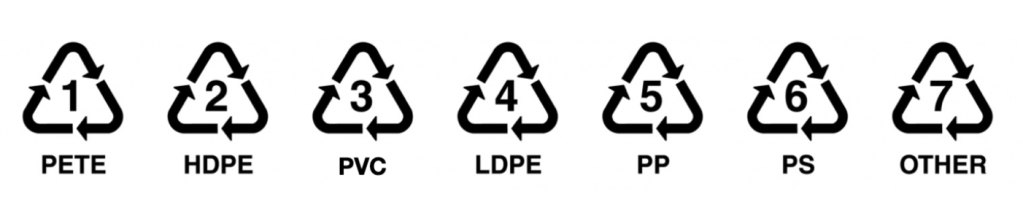
What are these “chasing arrows” and what do they mean?
As reported by Michael Corkery in the New York Times, beverage companies, retailers, and many of the nonprofit groups they control constantly and successfully kill states’ attempts at bottle bills. Want to guess how many states have passed a bottle bill since 1987? Only one, Hawaii!
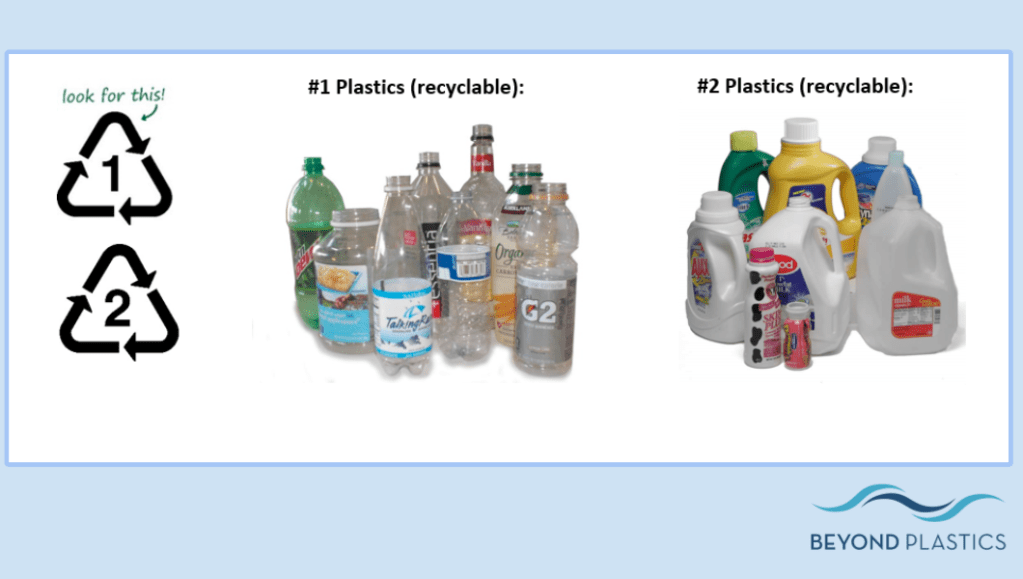
So it all falls on you! Recycling in the U.S. depends almost entirely on your good will to bring items to your transfer station or place into a bin for pickup. This convenient process means millions of plastic bottles end up in landfills or even worse are incinerated, with plastic snack packages facing a similar fate. Sadly, much of it eventually ends up as microplastics in the ocean or toxins in the air. This outcome can be explained because the “chasing arrows” you see on bottles and packages with the numbers 3, 4, 6 and 7 cannot be recycled at all, and with #5 there’s often no market so municipalities do not collect them. Only #1 and #2 plastics can be recycled, and not effectively at that.
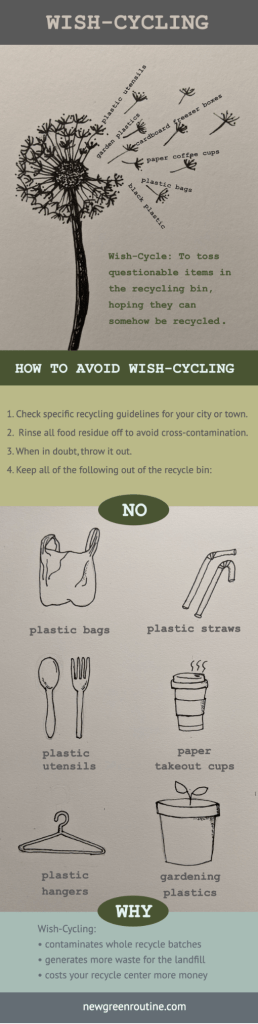
Perhaps you’re like I was and tossing all of your plastic — #s 1 to 7 — all together into your recycling bin. There’s a term for that: wish-cycling. Wish-cyclers toss questionable items in the recycling bin hoping they can somehow be recycled. Please peruse the graphic below from new green routine to understand wish-cycling, how to avoid it, and why.
Ease Away from the Blame Game
I’ve done my best to show you two things that are not your fault. First, you have been undermined by certain parts of the food and beverage industry to crave sweet and salty foods — foods with fat, too, but I’ll have to write more about that at another time. Second, they have duped you into thinking that recycling works. This industry is powerful and has billions and billions of dollars they can put to use to trick you.
By giving a green light to the produce section and putting a stop sign on the chip aisle, you can ease away from unhealthy foods and ease away from plastic pollution at the same time. In turn, the food environment in your home will be healthy and earth’s environment will be healthier, too!
 Healthy You • Healthy Earth • Healthy You
Leave a comment